Creating a supportive and understanding environment at home is crucial for children with neurodiverse behaviors. This blog post offers practical tips for parents and caregivers on how to manage behaviors in a way that promotes positive change and emotional growth.
In the latest data published on permanent exclusions and suspensions in England in 2021/22, the highest rate of suspensions and exclusions was for those who have SEN without an Education, Health and Care Plan (EHCP). The most common reason for suspensions and permanent exclusions in 2021/22 was ‘persistent disruptive behaviour’.
To bring these figures down, we need to take a holistic and collaborative approach to understanding behaviour. By looking at the when and why, we can provide appropriate support for learners to addressing any barriers to education. A tool that we find is particularly effective in providing a person-centred response to reducing the risk of breakdown within our BeyondAutism Fast Responder® service, is the ‘behaviour cycle’.
What is the behaviour cycle?
The behaviour cycle tools are adapted from the ‘crisis’ or ‘escalation’ curve, which show the stages of a crisis/escalation, and have a dual function;
- To identify what is observed for the individual across the various stages of a ‘crisis’ when considering behaviours that challenge.(Download a visual representation of the behaviour cycle here)
- To identify strategies to support the learner that correspond with the stage of the cycle being observed.
The colours used within the cycle correspond with those used in the Zones of Regulation, and can be used alongside a learner’s emotional regulation programme.
Whilst the behaviour cycle is typically used with those that support a learner (parents, teachers, teaching assistants etc.), the tool can also be used by the learner themselves. It can be used to map out body sensations, thoughts, actions and feelings based on the stage of the cycle, to provide a visual guide with regulation strategies.
Why is the behaviour cycle useful?
The primary aim of the behaviour cycle is to bring together a learner’s team through a workshop model. It helps to develop a consistent and person-centred understanding of the behaviours observed, and what strategies to introduce based upon which stage of the cycle the learner is in.
There are several other benefits of behaviour cycles:
- Team workshops allow for group reflection; and can enhance team collaboration and support, which allows for greater consistency in the understanding and implementation of strategies.
- They are visual and can be used by the learner themselves.
- It allows you to identify early warning signs to implement strategies to prevent escalation.
- Can consider the team’s/parents’ own behaviour cycles, to reflect on where they may be within the cycle compared to the learner, and consider their own regulation strategies.
“The child feels safer and calmer, and the consistent approach used has meant incidents of dangerous behaviours have reduced.”
SENCo is participating in the BeyondAutism Fast Responder® pilot, following the behaviour cycle workshop.
Implementing the Behaviour Cycle workshop
It is key that the behaviour cycle tools are created within a team workshop, with all team members present that support the learner. This is to ensure that all observations are captured, and a consistent understanding of the observations and supports are achieved.
Stage 1: Identify the perceived functions of behaviour
Prior to the workshop, the reasons behind the behaviour must first be identified. This is imperative, to ensure that the strategies put in place are effectively meeting the needs that the learner is communicating with their behaviour. If the strategies are not evidence-based upon the needs being communicated, they may result in an increase of behaviours that challenge, or fail to effectively support the learner’s environment, or teach the learner an alternative way of communicating their needs.
See our blog on identifying functions of behaviour for more information.
Stage 2: Behaviour Cycle; the observations
The aim of this stage is to review the observed behaviours across each of the stages/zones of the behaviour cycle. From calm/regulated/happy, to early warning signs, to the behaviours that challenge, and finally the regulating stage.
Green zone:
Consider what ‘calm, happy and regulated’ looks like for the learner. What activities might they be doing? Are there particular times of the day when the learner is in this space? Who are they typically with?
Other things to consider include; What and who is important to the learner? What are the learner’s individual strengths and interests? What are the learner’s facial expressions/body language/tone of voice that tell you they are in the green zone? Also consider this for those supporting the learner.
Top tip: Monitor how often this zone is being observed through a tick/tally sheet, as this is the zone we want learners to spend the most time in. Check if this increases following intervention implementation. Monitoring the green zone as opposed to the red zone can help to shift the focus away from the behaviour that challenges, which can change an often negative narrative to instead focus on increasing quality of life.
When quality of life is prioritised and increased, and the learner’s needs are met, a decrease in behaviours that challenge is more likely.
Yellow zone:
This zone represents the early warning signs that indicate that the learner may be moving away from a calm/regulated/happy space. It also considers the triggers and setting events that lead to the occurrence of the early warning signs and subsequent behaviours that challenge.
- Identify the triggers. These are the events that are most likely to ‘switch on’ the behaviours that challenge.
- Identify the setting events. These are internal states such as being hungry, tired, bored, or prior events that may impact on the learner’s coping when triggers are present.
- Identify the early warning signs that indicate that an escalation to behaviours that challenge is likely by considering the following;
● What is the first sign that indicates the learner is moving away from the green zone?
● Consider discrete signs, take a step back and observe.
● Discuss the subsequent steps – it may be helpful to role play this.
● Consider tone of voice and body posture of the learner and those supporting.
● Do those supporting ask lots of questions/place demands/talk a lot?
Red zone:
The red zone is where the behaviours that challenge occur.
What does this look like to you, but also what does this look like from the learner’s perspective? Is there lots of talking from those supporting? Too many choices? Are they having physical restraint used or other restrictive practice? Do others come to support?
Could this be helping or maintaining the behaviour – thinking back to the functions of behaviour? Remember though, having a second person is needed for safeguarding, monitoring safety, and also to support the staff member supporting at that time.
Blue zone:
This is where the learner may be beginning to regulate and/or calm.
What are the first signs that indicate this move away from the red zone, then what subsequent signs are there? What does the environment look like that contributes to this? How do those who are supporting feel?
Stage 3: Behaviour Cycle; the strategies
Once we’ve made our observations, it’s time to start working on strategies to support our learners. These must be based upon an understanding of what needs are being communicated through the behaviours, and be person-centred!
Green zone = Proactive strategies
These are the strategies that maintain a regulated, calm and happy space, that meet the learner’s needs and prevent escalation.
Some examples that may be considered are below.
Relationships
- Establish a key adult to build rapport and facilitate regular check-ins
- Engage in the learners’ interests
- Consider attention levels; are they able to access and build positive relationships, and if so, how frequently?
- Social skill building; do the learners and their peers need support around navigating friendships?
Routine
- Visual supports (daily/weekly planners, activity schedules), timers, countdown strips. Download some fantastic visual resources over in our resource hub.
- Incorporate interests, considering motivation – use now/next boards
- Choice built in where possible
Regulation
- Identify calming strategies, which should be built into routine e.g., sensory diet
- Teach alternative skills e.g., to ask for a break when needed – designated safe space
Yellow zone = Active strategies
By observing the triggers of changes in zones we can implement active strategies when early warning signs are observed.
Some examples may include:
- Redirection to other activities
- Engaging in interests
- Low arousal approaches: reduce demands, monitor tone of voice/body posture to model ‘calm’, consider sensory input
- Going through regulation activities/alternative communication
- Validate and empathise
- Using clear, reduced language
Red zone = Reactive strategies
The aim of reactive strategies are to keep the learner and others safe.
Strategies to consider here may include:
- Giving space
- Reducing language; using scripts to ensure language is consistent across all supporting
- Scanning the environment for any potential risks
- Seeking support for yourself and others if needed
Show empathy: let the learner know you are there for them
Blue zone = post-reactive strategies
Post-reactive strategies should be put in place to support regulation following an behaviours that challenge, with sensitive management.
Strategies to consider here may include:
- Self-check-in, are you ready to re-engage even if the learner is?
- Re-engaging but keep language to a minimum
- Restoring relationship – engage in interests
- Gradually reintroducing the routine/visual supports and choice
- Regulation tools
- Avoid talking about the red zone here, it is unlikely that the learner is ready for any reflection.
The behaviour cycle tools can form a person-centred plan for a learner, to focus on building a more positive school experience, and reducing barriers to learning. The positive impacts for those supporting the learner can also be achieved by developing collaboration through providing a reflective space. With the high rates of suspensions and exclusions for those who have SEN, leaving some without an education, a different, more individualised approach is needed to be taken.
“Emotional regulation” is a term generally used to describe a person’s ability to manage and respond to an emotional experience. Emotion regulation is also known as emotional self-regulation.
When supporting your child to regulate their emotions, you need to be aware of:
- Your own emotions – this is important to ensure you have self-regulated before supporting your own child so that you can model calm and regulation to your child. See the factsheet titled Parent Mental Health Fact Sheet for further information on self-care as a parent
- Your reaction to these emotions; and
- How the above may affect your child’s emotions (also known as co-regulation).
Please press Ctrl and left click to find out more about Emotional Regulation
Co-regulation
Younger children in particular will need your support to regulate their emotions as they may be too young to understand the ‘big feelings’ they are feeling. This can also be true of older children, particularly in times of crisis. This is called ‘co-regulation’.
Stages of co-regulation:
- Self-check in. Are you in a space where you can provide a calm presence? If not, take the steps to regulate yourself first if you are able to
- Get close to your child and listen to them, tell them you are there for them
- Let your child know that you want to understand the best that you can. Listen to them
- Empathise and validate what your child is sharing. It can be helpful to give examples of where you may have experienced something similar, however be mindful to ensure that your child is the focus. Continue to listen
- Remind your child that you are there for them, offer affection in a way that is appropriate for them and with their consent
- Ask if they would like to have space, or suggest a calming activity. Remind your child that you are always there for them
Self-regulation
Learning to regulate emotions is a skill that helps children develop ways of substituting impulsive reactions with regulating activities that supports their mental health.
To aid your child with this you can use a framework/curriculum designed to help recognise feelings, and tools and strategies to help regulate them called Zones of Regulation.
Zones of Regulation
Zones of Regulation teaches children scaffolded skills to build awareness of their feelings/internal state, exposes them to a variety of tools and strategies for regulation, prosocial skills, self-care and wellness. It is a systematic approach to teach regulation by categorising the different ways we feel into 4 coloured zones. Zones of Regulation respects the individual and unique self and helps children become more independent in regulating their emotions.
When supporting your child’s emotion regulation there are steps to follow with increasing complexity.
1. Emotion recognition
It is important that your child can recognise their own emotions and in others. In Zones of Regulation, emotions are divided into 4 categories:
Image
Start to introduce your child to the words and visuals, incorporate them into activities your child finds motivating. Once they are familiarised with them, you can introduce activities of matching and categorising into zones. Use visuals to talk about different situations, e.g., a picture of a boy crying after he fell from the bike. You can also use visuals to check in, ask your child how they’re feeling at different points during the day, you can have a poster on the wall, or small visuals on a keychain.
To learn about emotions in others you can use characters from TV shows, books or real-life opportunities.
Below are some helpful ways of teaching emotions:
- Teach one emotion at a time starting with the emotion that is easiest for your child to grasp
- Say that you wonder if they might be feeling ‘emotion’ e.g., happy because you can see that they are smiling
- Use a family Zones of Regulation chart to model emotions and speak about these within the family
- Ensure that all feelings are validated, and avoid use of negative language to associate with feelings of ‘anger’. Validate by saying, ‘it is okay that you are feeling angry right now’. Avoid the focus of teaching the Zones of Regulation to be to ‘get back to green’ as this again can build a negative association with feelings other than ‘calm’ or ‘happy’.
Ultimately, it is most important to make learning person-centred to your child and what works for them!
2. Emotion coaching
Emotion coaching is a technique by which a child is supported to recognise their emotions and come up with a plan to help them solve the problem.
These are the steps for Emotion Coaching:
- Tune in: Notice or become aware of your own and your child’s emotions. Make sure you are calm enough to practise emotion coaching; otherwise, you might want to take a break.
- Connect and validate: Use this situation as an opportunity for you to practise and for your child to learn. State what emotions you think your child might be experiencing to help them connect their emotions to their behaviour and validate these emotions: ‘I’m wondering if you are feeling angry. It is okay to feel angry’.
- Practise empathy: Put yourself in your child’s shoes, think about when you felt a similar emotion, and try to remember what it feels like.
- Reflect: Once everyone is calm reflect on what happened and why it happened.
- End with problem solving and setting limits: Whenever possible, try to end the situation by guiding and involving the child in problem-solving.
Toolbox
Using Zones of Regulation can provide your child with a visual cue to access these problem-solving strategies. The visual cue is called a Toolbox. Toolboxes include strategies to help regulate your child in each zone. These will be individualised and are best created as a guided activity with your child.
3. The behaviour cycle or ‘crisis curve’
What is the behaviour cycle?
The behaviour cycle tools are adapted from the ‘crisis’ or ‘escalation’ curve, which show the stages of a crisis/escalation, and have a dual function:
- To identify what is observed for the individual across the various stages of a ‘crisis’ when considering behaviours that challenge.
- To identify strategies to support the learner that correspond with the stage of the cycle being observed.
The colours used within the cycle correspond with those used in the Zones of Regulation, and can be used alongside a learner’s emotional regulation programme.
Whilst the behaviour cycle is typically used with those that support a child (parents, teachers, teaching assistants etc.), the tool can also be used by your child themselves. It can be used to map out body sensations, thoughts, actions and feelings based on the stage of the cycle, to provide a visual guide with regulation strategies.
For an example of a behaviour curve see our website or read our blog on Understanding the behaviour cycle.
Autism, mental health and wellbeing
Mental health and wellbeing are defined as a ‘state of wellbeing in which each individual realises his or her own potential, can cope with the normal stresses of life, can work productively and fruitfully, and is able to make a contribution to his or her community’ (World Health Organization, WHO).
All children and young adults will experience changes in their mental health whilst in schools and educational settings – it is important to remember it is completely normal to feel worried, anxious or stressed at times. However, it is also important that we have the tools, strategies and support to manage these periods effectively. Some children and young adults may encounter significant life-changing events which can seriously impact their well-being, and this can include mental illness.
Autistic children and young adults need support during times of change and to access help when needed. In autistic individuals, mental health issues such as anxiety, can present as not cooperating or engaging in disruptive or aggressive behaviours.
Some potential triggers that may be observed include the following:
- Psychological: Possible sense of failure, unsure what is expected of them, obsessive compulsive disorder/attention deficit hyperactivity disorder or diagnosis of a mental health condition, hyperactivity, ritualistic behaviours
- Environmental changes: Others becoming upset, loud noises, unexpected noises, changes to routine, unfamiliar places, changes at home
- Personable: Change in contact with familiar people (e.g., teacher leaving school), family member no longer around/on holiday, death of an individual close to them, presence of unfamiliar people
- Medical: Pain, seizures, side effects of medication
To understand why there are changes in behaviour, we need to understand what lies beneath the behaviour. We can use the ABC model to help gather more information about the behaviour and find ways to support.
Antecedent
What happened just before the behaviour, what changes happened in the environment?
Behaviour
What did the behaviour look like?
Consequence
What happened just after the behaviour happened? What was the reaction or actions
of people or themselves?
For example:
| Setting event (info from home) | Antecedent (what happened just before the behaviour) | Behaviour (what did the behaviour look like) | Consequence (what happened immediately after the behaviour) |
| Slept only 5 hours, did not eat breakfast. | Unexpected noise. | Crying, hiding. | Access to ear defenders, a quiet space. |
See our factsheet on Understanding behaviours for more information.
To support your child’s mental health, the following skills can be taught:
| Skills | Strategies |
| How to communicate needs and wants | Teaching communication skills. ● Your child may find it difficult to communicate effectively when they are feeling overwhelmed. Providing alternative ways of communicating such as a choice board or pointing may help. ● Teach how to request for help or breaks when in an overwhelming environment. ● Say or point to the name of the item/ activity/ location they want so they can repeat after you. |
| Understanding emotions | ● Speak to your child when you are experiencing an emotion yourself, and what things you do to help yourself. ● Listen to and validate if/when your child expresses their feelings to you. ● Label emotions you see on videos or other people around you. |
| Expressing emotions | Acknowledge and reward appropriate safe ways of expressing emotions e.g., “Thanks for telling me you are upset, let’s talk about it”. |
| How to use strategies to regulate their emotions and manage stress | ● Trial a range of new activities. ● Monitor which activity can be a strategy to calm when upset or overstimulated. ● Redirect to these strategies when they are finding it difficult e.g., squeezing a stress ball, going for a walk, or writing etc. |
| How to make and maintain positive relationships with others | ● Engagement in PSHE lessons. ● Teaching about personal space or others likes and dislikes/how to be a friend/paired or group work or play activities. |
| How to cope with change | Visual stories (see our resource ‘What is a visual story?’). |
Understanding and approaching behaviours that challenge
Research shows that 59% of autistic individuals engage in one or more behaviours that are perceived to challenge¹.
Definition
Behaviours that challenge are behaviours defined as ‘challenging’ if they are particularly intense, frequent, or lengthy in duration – such behaviours pose a risk to the person and others and can impact on quality of life.
Some behaviours that can be observed include physical aggression such as hitting or kicking, verbal aggression such as swearing or spitting, self-injurious behaviours such as biting self and risky behaviours such as running away or stripping.
Functions of behaviour (what is a behaviour communicating?)
Behaviours that challenge occur for a reason – they serve a function for the individual. Often, the behaviours occur because the individual has difficulties with communicating their wants and needs. In order to understand the behaviour, we must understand the relationship between the individual and their environment. The environment can include situations, places, people, and activities that may trigger episodes of behaviours that challenge. By changing or adjusting the environment, this can greatly reduce behaviours that challenge.
If your child is unable to say they are feeling unwell or in pain, they may engage in behaviours that challenge. Medical causes must be explored and ruled out first with your child’s GP and/or other medical professionals.
There are four main functions of behaviour:
Escape/avoidance
Some behaviours occur as a person wants to get away from something or avoid something completely. This is known as escape or avoidance. If a task is too hard, boring, or even too easy, behaviours that challenge may occur to communicate this. Examples of escape behaviours include blocking ears if they want to block out a loud noise, or running off when a task is difficult. Examples of avoidance may include having a tantrum when the school bus arrives. The tantrum results in the individual staying at home and avoiding a negative environmental factor such as a difficult lesson, an exam, or a bully.
Attention
A child or young adult may engage in behaviours to gain some form of social attention. The desire for social interaction is present and this can include even negative attention or reactions from peers
and adults.
Tangible
A tangible function of behaviour includes gaining access to items or activities. A child may run towards, grab, or cry for items or a desired activity.
Sensory
Some behaviours are repeated by an individual because they provide some form of sensory feedback. They feel good, are satisfying and self-stimulating. Examples might include playing with hair, tapping your foot or chewing a pen.
Assessing the function
Antecedent Behaviour and Consequence or ABC forms are commonly used as a means to record instances of behaviours that challenge, writing down what happened before (antecedent), what the behaviour was, and what happened after the behaviour (consequence).
| Antecedent | Behaviour (What is the behaviour?) | Consequence (What happens after the behaviour?) | |
| Setting (Where, when, who with) | Trigger (What happened directly before the behaviour happened) | ||
Once you have a number of examples, look at the patterns, and review which function of behaviour it may be that the behaviour is communicating. Patterns you may identify include whether the behaviour occurs at the same time in the day, after a specific event or with a specific person.
Teaching alternative behaviours
Once we understand what a behaviour is communicating, we can teach an alternative way for your child to communicate their needs more effectively.
Escape/avoidance
They can be prompted to either ask for help, delay the task, ask for a break or ask for work that is more challenging. Prompting for a functional communication response can result in the demand being delivered at an appropriate/ individualised level. You could also review the task – is it too easy, too hard, or uncomfortable in some way? Look at ways to adjust the task to make this more accessible for your child.
Attention
If your child is communicating that they would like attention through their behaviours, proactively schedule in more of the preferred attention and show when this is available on a visual schedule. You can also teach your child alternative ways of accessing attention e.g., by tapping an adult’s shoulder, saying ‘excuse me’ vocally or even using adult names.
Tangible
If behaviours occur when your child wants something, proactively schedule in more of the preferred item and show them when this is available on a visual schedule. They can also be prompted to request an item in an alternative way e.g., using the PECS (Picture Exchange Communication Systems) symbol for a drink, or using their vocals to say ‘iPad’.
Sensory
If sensory behaviours occur, the person can be modelled an alternative, safe behaviour e.g., instead of biting their hand, they can bite a chewie. Only teach an alternative if the sensory behaviour is unsafe, e.g., head banging or
self-biting.
Top tips for managing behaviours that challenge
There are a few things you can do to help manage behaviours that challenge:
- Identify the common triggers (antecedents) in the environment that you may be able to adjust or adapt
- Identify your child’s preferred method of communication so that they can express themselves including their wants, needs, frustrations, discomfort or pain
- Offer your child some choice so that parts of their day include engaging with events, people and activities they prefer and gaining attention from who they want
- Develop their coping strategies for when these preferred activities, events or people are not accessible – this can include breathing or counting exercises or access to fidget toys
- Model the behaviour you want to see and recognise these positive behaviours when they occur
- Respond calmly to the behaviour; this may include not commenting on the behaviour, giving your child some space or offering them a quiet space or a regulating item or activity
- If you are worried that your child is engaging in behaviours that are perceived to challenge, seek out advice and support from friends, family and professionals if necessary.
- Please speak to your GP who may be able to refer you to another professional.
References
- Autism Research Institute, 2021 Challenging behaviors in adults with autism – Autism Research Institute
Advice for parents of children with autism
By Longwood House April 29, 2021
Caring for your child’s teeth can be challenging at the best of times, but for
parents of children with autism there may be additional challenges.
The British Society of Paediatric Dentistry (BSPD), the organisation of dentists who care for children’s teeth, has assembled some advice for parents of children with autism. In this blog, we have summarised this advice and do hope you find it helpful.
Children with autism often process sensory information differently, and they can be either less sensitive or extra sensitive to sights, sounds, smells, tastes, and touch. Having your teeth brushed and visiting the dental surgery can really challenge the senses. Sensory issues can be one of the main anxiety triggers for the autistic child in the dental surgery.
Fear of the new and unknown can also be overwhelming. If a child has learning difficulties, they may not understand what is planned; therefore, extra care is needed both in preparation for and during the dental visit. In addition, the dental staff may not be familiar with the child’s method or style of communication.
Some children have other medical conditions in addition to autism, such as ADHD or epilepsy, which pose their own challenges too.
All these factors can influence how a child copes, not only with oral care at home but also with seeing the dentist. Find a dentist who understands autism and can support you and your child.
Is my child more likely to get dental decay because of their autism?
All teeth are susceptible to tooth decay if exposed to sugary foods and drinks between meals, especially baby teeth, which have thin enamel. Current research suggests that a child with autism is no more susceptible to tooth decay than any other child.
Some medications can cause a dry mouth; in these cases, dental decay is more likely. Some prescribed medications or supplements may contain sugar. Do request a sugar-free alternative from your child’s doctor.
Getting your child off to the best start
Tooth decay is almost always preventable, and by getting things right as early as possible, you may be able to avoid your child needing dental treatment. This is particularly important for children with autism because they may find dental treatment more challenging.
It is also easier to develop good behaviours from the outset, rather than trying to change behaviours that are bad for dental health once they have become established. As soon as your child gets their first teeth, and certainly, before their first birthday, it is time to arrange their first check-up.
Toothbrushing at home

Brushing your child’s teeth at home is important. However, many children with autism find toothbrushing difficult to tolerate and it can become quite a battle! Ideally, toothbrushing should be introduced as soon as the first tooth comes through so that it becomes part of their daily routine. Brush before bed and at one other time using fluoride toothpaste.
Toothbrushing at home – The parents’ role
It’s recommended that all children are supported to brush their teeth until the age of about 7 years, as they do not have the precise hand skills to clean their teeth effectively. Autistic children may need help for longer than this. It may help to have two brushes – one for you to hold and one for your child, as this will help them feel in control of the process.
What is the best way to brush my child’s teeth?
Stand or sit behind your child, so that you can see where you are brushing while supporting your child’s head. Your dentist, hygienist or therapist should be able to recommend positions and strategies.
When should we brush?
Ideally, twice every day – just before bed and at one other time. Before bed is most important as the fluoride from the toothpaste will stay on the teeth whilst your child is asleep. Remember to encourage your child to spit out excess toothpaste. Discourage rinsing after brushing so the benefits of the fluoride last.
Which toothpaste should we use?
Some children don’t like the taste and texture of toothpaste and may prefer brands that are flavourless or low foaming. If you are really struggling, try brushing teeth with water first and then rinse the brush and dab some fluoride toothpaste around the teeth. Ask your dentist about the different types of toothpaste available. The most important thing is the right amount of fluoride. Ask your dentist whether your child might benefit from using a higher fluoride toothpaste, which can be prescribed for children over the age of 10.
Should I buy an electric toothbrush?
A child’s teeth can be brushed perfectly well with a normal (manual) toothbrush; in fact, for some autistic children, an electric brush can be very disturbing. However, if your child has sensory-seeking behaviours, then they may enjoy using an electric toothbrush. Older children may find it easier to use, especially if they have dyspraxia. If you do buy an electric toothbrush, choose one with a small oscillating head. You can buy special toothbrushes that brush the sides and the top teeth at the same time. This can help, especially if your child enjoys chewing the brush.
Because it can be difficult to brush an autistic child’s teeth, their mouths may have more plaque, and the gums can become red, inflamed and bleed. The good news is that with improved and regular cleaning, the bleeding will stop and the gums will become firmer and look a healthy colour.
Diet and dental health
Dental decay is caused by sugar. There may be challenges for parents around choosing foods and drinks which are low in sugar. Your child may:
- be more likely to have feeding problems than non-autistic children (often linked to sensory needs)
- eat a narrower range of foods
- have a strong preference for foods of the same colour or with familiar packaging
It’s important to try and limit the number of times a child has sugary foods and drinks during the day – try to keep them to meal times. Aim for safe snacks between meals which are low in sugar!
Choosing your child’s dental team
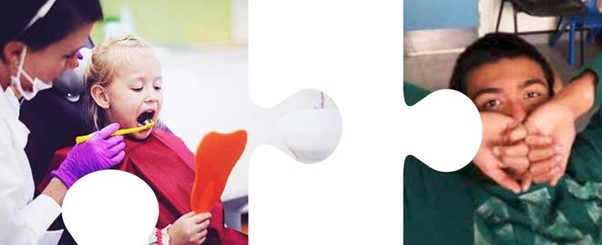
Many autistic children are successfully treated by their family dentist; however, your local practice may not offer the right service for your child. Autistic children need time to settle into a new environment, and you need an experienced team who will recognise this and not hurry your child.
Many parents choose to take their child to an experienced Paediatric Dentist working in a Community Dental Service (CDS), particularly where the child has a significant learning disability or other medical conditions. You can find your nearest CDS by asking at your local dental practice. Many children prefer not to be kept waiting amongst other patients or in an unfamiliar environment.
My child’s first check-up
From the moment you enter the waiting room, dental practices can be bright, noisy, and very busy places. Many children find this distressing, but providing the practitioner has been informed about your child’s sensory needs, consideration and sensible adjustments can be made to minimise the distress a child may feel. For example:
- Make sure the practice staff knows in advance that your child is on the autistic spectrum.
- Try to arrange one (or more!) quick “hello” visits beforehand so that your child can get used to the journey to the surgery, to the environment, and to the people there.
- Ask if you can take photos on your phone to make a picture story (social story) of the dental appointment and what will happen.
- Some dentists will ask you to fill in a questionnaire, which specifically asks how autism affects your child, e.g. sensory areas, likes, and dislikes, dietary preferences, and communication aids. A sample questionnaire can be found on the BSPD website for you to fill in yourself and take to the dentist:
- Ask for a visit at the beginning of the day when the waiting room is likely to be quieter, so that the child will not have to wait too long to be seen. You can ask to wait in the car and be called when the dentist is ready.
- Take anything with you which might help your child to settle and feel less anxious in the new environment, e.g. toys, iPad, blankets
- Ask your practice if there is a particular dentist who has an interest or experience in caring for children with autism.
How do I know if my child has toothache?
Children with autism may have difficulty in expressing pain. It is therefore important to keep an eye out for unexplained changes in behaviour, such as disturbed sleep, otherwise unexplained emotional outbursts, changes in patterns of eating, and self-harm.
Children who are sensory seeking might continually put their fingers or toys in their mouths or other objects. This is known as stimming. It is easy to think that the child is doing this because of a toothache, but this is not always the case. It is important to get this checked out by the dentist, as these habits can sometimes damage the gums or cause mouth ulcers due to friction.
What happens if my child needs dental treatment?
If your child is found to need treatment, there are usually several options available. The most suitable way of carrying out the treatment will be discussed with you and will depend on a few factors. These may include:
- The type and amount of treatment needed
- Your child’s age, understanding, behaviour and communication skills
- Sensory needs
Some children can accept dental treatment whilst they are awake in the dental chair if their dentist and the dental team take a slow and gentle approach. Other children may need extra help, such as inhalational sedation (happy air), which tends to work best for children who can communicate and are not too scared. The National Autism Society has excellent advice about going to the dentist.
However, other children may require treatment under general anaesthesia (whilst they are asleep). The advantage of this is that treatments can be done at the same time. All the teeth with decay will need to be treated to reduce the chance of this procedure having to be repeated.
General anaesthetics are usually carried out safely in hospitals with highly trained staff. Some of the disadvantages of this approach include the environment being unfamiliar, the family having to travel to the hospital, and food and drinks being restricted beforehand.
As with visiting the dentist, you can ask the clinical team if you can prepare your child with a photo journey. Also, you can ask your dental team when they make the referral if your child can be placed first on the list, to minimise waiting time.
It may be possible to work with a play therapist at the hospital who will support you and your child. You can also download symbols and storyboards (Widgit symbols, for example) from the internet to help prepare your child.
Contacting Longwood House Dental
At Longwood House Dental we are delighted to have Dr. Anand on our team. She is a specialist in Paediatric (Children’s) dentistry and Oral Surgery and completed her specialisation in Paediatric Dentistry at Guy’s Hospital in 2006. She was further awarded a fellowship in Paediatric dentistry at the Royal College of Surgeons, England.
She is also a Consultant in Paediatric Dentistry at RNENT & The Eastman Dental Hospital and was Awarded for Clinical Excellence in 2017 by UCLH NHS Trust, London.
The staff are aware of special needs and hidden disabilities and are experienced in taking care of children with all needs.
If you would like to have a consultation with Dr. Anand call us on 020 8551 0088 to book your appointment. We will also be happy to answer any questions you may have.